
Do Montessori Schools Give Homework? What Comes Home, and at What Age
Category: Insights
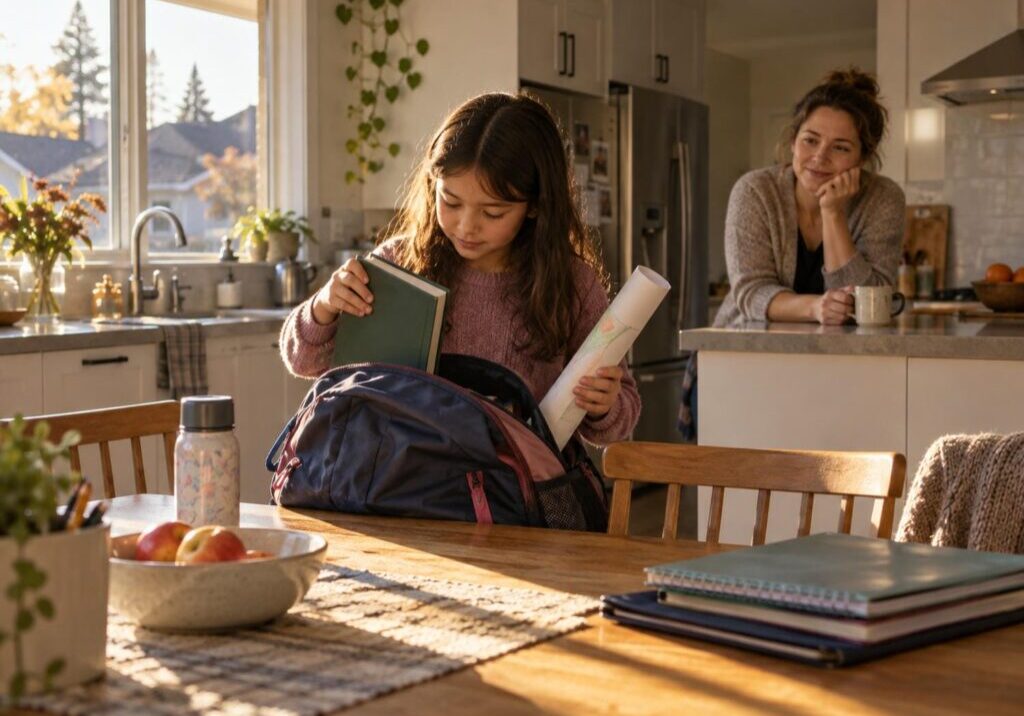
Some Montessori schools send work home and some send almost none. What Montessori homework looks like depends on how old your child is, and on which school you choose. The American Montessori Society puts the age part plainly: homework is unusual for the youngest students, and parents can generally expect that as children mature through the grade levels they will be given homework. When that happens, the expectation is about 20 to 40 minutes of work the child does on their own.
So practice does not disappear. It moves. In a Montessori elementary program most of the practising and consolidating that a conventional classroom sends home happens inside a long, protected work period during the school day, not at the kitchen table at seven in the evening. And if you want a number to hold it against, the public board down the road publishes its own daily maximums by grade.
How Montessori Homework Changes From Grade 1 to Grade 6
A Grade 1 evening and a Grade 6 evening are different questions with different answers. Montessori homework works as a staircase rather than a yes or no, because the practice is built to travel with the child. What moves with the grades is how much of that work the child is expected to carry alone.
Lower Elementary: Grades 1 to 3
At this age homework is unusual. Children aged 6 to 8 may be asked to read to a parent, or to finish a project that was started at school. Whether anything arrives at all in a given week varies. These are multi-age classrooms, where a child of six works beside a child of eight.
An empty folder at this age is not an absence of work. A child who reads before bed and spends Saturday morning finishing a map of the solar system has done work at home; it just did not arrive as a packet. What a parent should plan for at this age is time rather than tasks: time to read, and time to finish something that matters to the child.
Upper Elementary: Grades 4 to 6
The upper elementary years run roughly from age 9 to 12, and this is where the question changes. The same organization, describing its own elementary programs, puts work plans in the daily routine of the classroom, with children making their own work choices, prioritizing activities and meeting deadlines. Ontario, speaking to parents in the publicly funded system, says that in Grades 4 to 8 students begin to take on more responsibility and independence in their learning, and asks families to support planners, homework routines and time management.
More responsibility for completing homework is expected as children move up through the program. By the upper elementary years the work at home is as much about managing the work as doing it: a plan, a routine, and a deadline the child is keeping. That growing independence is part of what makes a Grade 6 student ready for high school.
Why Most of the Practice Happens Inside the School Day
Homework usually does one of three jobs: practise a skill, consolidate what a child already knows, or prepare for the next class. That is the definition the York Region District School Board works from. Homework can also be defined by its timing alone, as an assignment meant to be finished outside school hours. What makes something homework is when it is done and who set it.
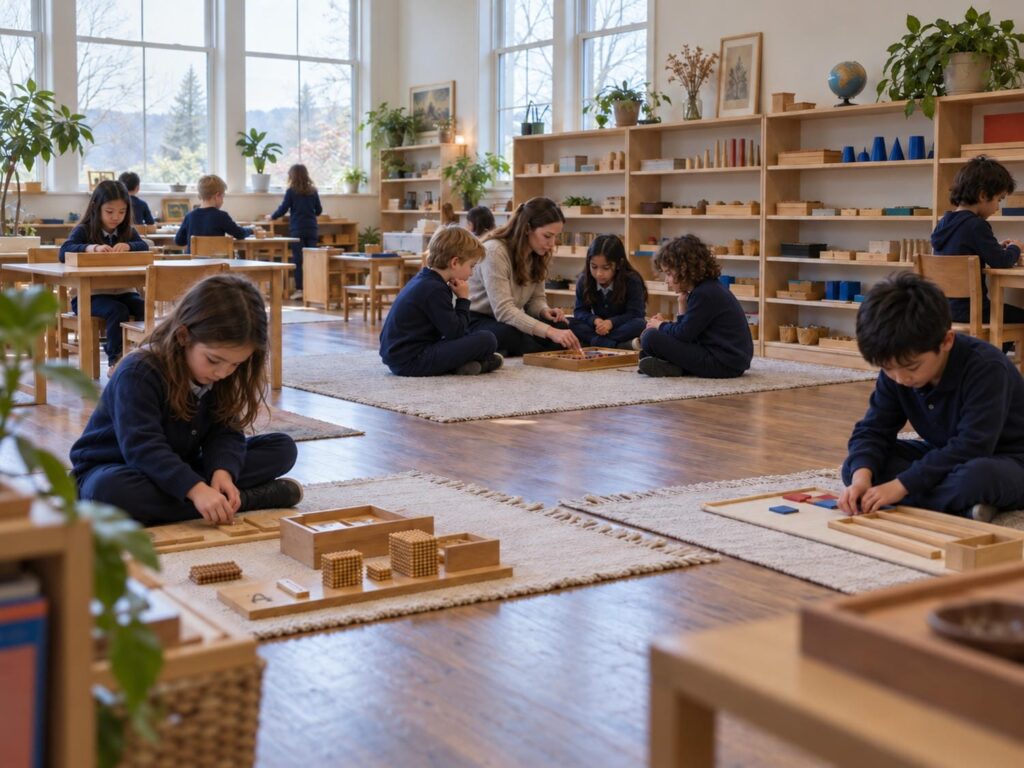
A Montessori elementary classroom is built so that the first two of those three jobs happen in front of the guide, with the material in the child’s hands. An empty folder is not the same as an empty evening, because plenty of what an elementary child does at home was never assigned.
The Three-Hour Work Period, and Why It Runs That Long
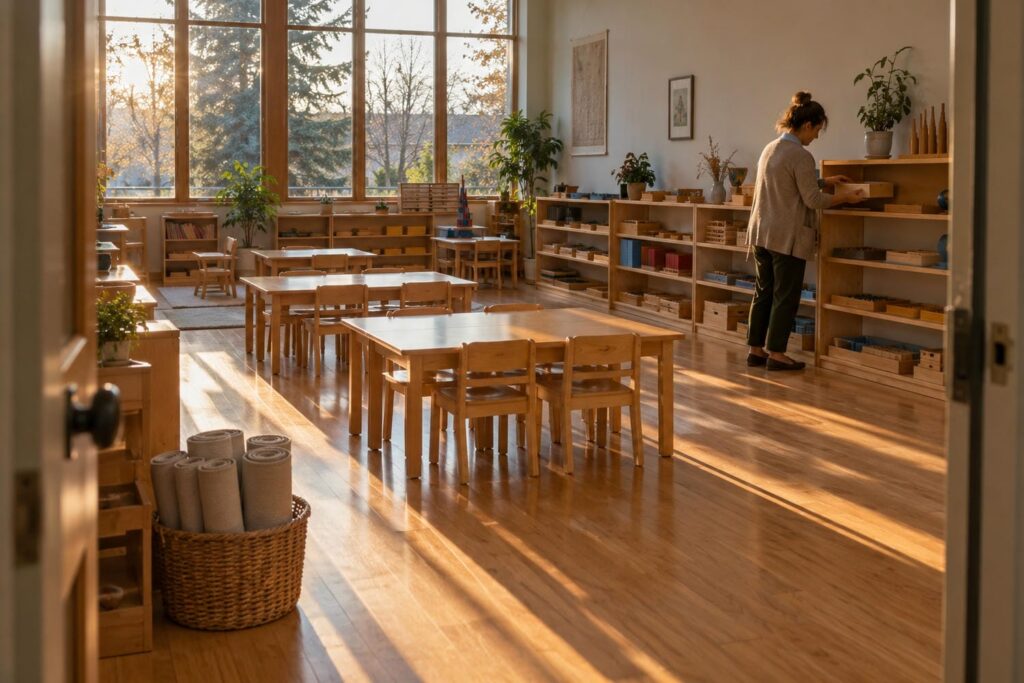
AMI/USA sets the shape of the day in its published classroom standards. A recognized AMI elementary classroom for ages 6 to 12 runs three-hour uninterrupted work periods, five mornings a week, with one session a week able to be left free for additional subjects. The three hours are a design intention rather than a stopwatch: some days the cycle runs under them, some days beyond.
The length is the point. Concentration in a child of this age is slow to arrive and easy to break, and a child given long stretches to work without an adult steering the activity will settle into absorbed, unhurried work. A timetable that cuts the morning into short blocks never lets concentration build at all. The three-hour morning is not an elementary invention either: the same standard sets three-hour mornings for the three to six classroom.
The Lesson, Then the Work
In a conventional classroom a lesson goes to the whole class at once. There is not time for every child to practise it to mastery, so the practice goes home. The evening is the only slot left.
A Montessori elementary classroom runs the other way round. The child gets a short lesson from the guide, alone or in a small group, then works with the material at their own pace during the work period while the guide moves on and observes. Follow-up work, repetition until it holds, material that shows the child their own mistakes: that is what the work period is for. Homework is not banned in Montessori. It is largely displaced, because the job it does elsewhere is already being done in class.
Reading, Projects, and Practice at Home
Something does come home from a Montessori elementary classroom, and it is usually work the child is already in the middle of: a book, a project started at school that is not finished, the planning for a trip the children are organizing themselves, or short practice of the things that genuinely need repeating. A packet of worksheets is less often what comes home.
Reading Earns Its Place at Home at Every Elementary Grade
Reading holds its place at home at every elementary grade because nothing about it depends on an assignment. Toronto Public Library asks the parents in its Grades 1 to 6 reading program, for children reading and writing below their grade level, to read with their child for at least 10 minutes every day and to have the child read back.
Reading together turns up in Ontario’s advice to parents of children in the primary grades too. The province asks families to read with their child, to find enjoyable ways to practise math at home, and to model a positive attitude toward it.
Reading does not stop mattering in Grade 5. A nine or ten year old working through a chapter book, or reading to find something out for a project, is doing the same work in a different shape. It is also the one thing at home that asks nothing of a parent beyond time and attention.
Projects That Follow a Child Home
An unfinished project is the kind of work that is hardest for a parent to recognize as work at all. Elementary children work on things that take weeks, and a child researching volcanoes does not stop caring about volcanoes at three in the afternoon. What looks like homework is often the child’s own project following them home, which is why asking a nine year old whether this is homework sometimes gets a puzzled answer. It was not assigned. It was chosen, and it is not finished.
Going Out: The Trips Children Plan Themselves
A going out is a trip the children themselves plan: to a museum, a library, a workshop, or an expert. It is arranged as part of their own work rather than booked for them as a class outing. Practical life at the elementary level shifts toward skills that help children connect with their interests in the outside world, organize their time, and take part in their community.
One going out program in a 9 to 12 class is described in the American Montessori Society’s own magazine, where sixth-year students plan outings into the community based on their interests and current studies, and teachers encourage them to be as independent as possible in both the planning and the execution. That is one classroom as that account describes it. The planning is often what a child is working on at home: the letters, the phone calls, the questions to prepare.
Memorizing Facts, and Hearing French at Home
Some things genuinely need repeating. Math facts and French vocabulary are the clearest cases, because the child needs the repetition rather than the explanation. That makes short practice at home worth doing, and it asks no teaching from a parent: times tables in the car, naming what is in the kitchen in French. A parent who could not explain a Montessori math material can still hear a child say the sevens.
French immersion adds a constraint worth being honest about. Second-language exposure outside the classroom is the hardest thing for a household that does not speak French to supply, and schools know it. Audiobooks, a cartoon in French, a few phrases at dinner: it is patchy by nature, and it is worth raising with a school directly.
Is There a Homework Rule, in Montessori or in Ontario?
There is no Montessori homework rule to point you to. The published standards cover the classroom, the materials and the teacher’s training. Separately, no Ontario law, regulation or requirement sets, caps or requires homework at a private elementary school. What each one does cover is the useful part, because it tells you what a school has already committed to before you ask it anything.
Which Bodies Set Montessori Standards, and What They Govern
There is no single canonical Montessori standard. AMI/USA publishes standards for recognized AMI classrooms, and Montessori Canada publishes General School Standards that every member and affiliate school has to meet. Four of those matter most to a parent: Montessori trained teachers, classes equipped with core Montessori materials, some multi-age grouping, and an uninterrupted work cycle the school commits to valuing. That last one is the Canadian echo of the three-hour morning.
Neither set mentions homework at all. What they govern is the school day: the room, the materials, the teacher’s training and the protected work cycle. The evening is left to each school, which is why the answer changes from school to school.
Whether Ontario Requires Homework at a Private School
Ontario describes private schools as businesses or non-profit organizations that must meet Education Act requirements but are independent of the Ministry of Education, and the province does not fund, regulate, license, accredit or oversee their operations. What it does require is an annual notice of intention to operate, filed by September 1, carrying basic information such as the school’s owner, principal, address and hours of instruction. The notice collects hours of instruction and nothing about work sent home. Homework at an Ontario private elementary school is a school-choice question, not a compliance question.
The province does talk to parents about homework, advising families to provide time and support for it each day and to build routines around it. Whether a school is inspected and whether private schools follow the Ontario curriculum are separate questions with their own answers.
How the Amount Compares With York Region Board Policy
The York Region District School Board’s homework policy sets daily maximum homework times by grade band: 0 to 20 minutes in Grades 1 to 3, and 0 to 40 minutes in Grades 4 to 6. Kindergarten is 0 minutes, and the ranges climb to 0 to 50 minutes in Grades 7 to 9 and 0 to 90 minutes in Grades 10 to 12. The same policy directs that homework is not assigned over school holidays, on significant faith days, PA Days or weekends.
The policy’s own floor is the part a parent should notice. It states that there is no minimum amount of time that must be assigned. Teachers use their professional judgment according to each student’s learning profile and well-being, without going over the published maximums. So zero minutes is inside the board’s own policy at every elementary grade, and a Montessori classroom that sends little or nothing home on a weeknight is inside the range the local public board sets.
What the Research Says About Homework at Elementary Age
The real fear behind this question is not worksheets. It is whether a child who brings nothing home falls behind one who brings a folder home every night. The answer turns on the child’s age.
Homework Time Tracks With Achievement for Secondary Students, Not Younger Children
Harris Cooper, the researcher who synthesized dozens of homework studies published between 1987 and 2003, states the finding plainly. The average correlation between time spent on homework and achievement was substantial for secondary school students, but for elementary school students it hovered around no relationship at all.
That is not a verdict that homework is pointless. The amount of time an eight year old spends on homework is a poor predictor of what that eight year old learns, so minutes are a weak yardstick for a parent at this age. What is worth asking a school is where the practice happens and what goes on inside it.
How Much Is Reasonable, and Where the Ten-Minute Rule Fits
The same researcher’s guidance on amounts is more concrete. For children in Kindergarten to Grade 2, homework is more effective when it does not exceed 10 to 20 minutes a day, and older children in Grades 3 to 6 can handle 30 to 60 minutes a day.
Set those beside the Montessori figure. The 20 to 40 minutes the American Montessori Society describes for homework when it is given sits at or below the local public board’s ceiling for Grades 4 to 6. It also sits at or below that research guidance for the same age. The figure is a length of time, with no description of the task attached.
You have probably heard the ten-minute rule. Ten minutes a night per grade, so about 40 minutes in Grade 4 and roughly two hours for a high school senior. Many American school districts use it as a guideline.
Three different kinds of authority sit behind those numbers: one describes what is typical in Montessori practice, one is a researcher’s guidance on what children can handle, and one is the York Region District School Board’s policy ceiling.
| Grade band | Typical Montessori practice, as described by the American Montessori Society | What Harris Cooper’s research guidance suggests is reasonable | York Region public board daily maximum |
| Grades 1 to 3 | Homework is unusual for the youngest students. Children aged 6 to 8 may be asked to read to a parent or to finish a project started at school | 10 to 20 minutes a day to the end of Grade 2, rising to 30 to 60 minutes from Grade 3 | 0 to 20 minutes a day |
| Grades 4 to 6 | More responsibility for completing homework is expected as children move up. When it is given, about 20 to 40 minutes the child does on their own | 30 to 60 minutes a day | 0 to 40 minutes a day |
Why the Answer Still Changes From School to School
Two schools can both call themselves Montessori and answer this question differently. The published standards stop at the classroom door, so the evening is a school-level decision, and it depends on the school as much as on the child’s age. It is worth knowing why before you ask the question on a tour.
One American Montessori School That Let Children Choose
One school’s homework change was studied and written up. It is a publicly funded charter school in the United States, which matters, because Ontario has no charter schools. It had been giving homework much like a traditional public school’s, including worksheets and rote skill practice. Feeling that traditional homework was misaligned with Montessori practice, the administration changed the policy for the 2016 to 2017 year so students chose what to do each night.
Scott and Glaze, writing in the Journal of Montessori Research, found that students enjoyed the change, but that it lacked sufficient structure for parents, and that students needed support from teachers and parents to engage in meaningful homework tasks. One school, studied once. The lesson is not that choice fails. It is that free choice alone is not a homework policy. Whatever a school sends home, parents need to know what it is for and what their part in it is.
What Pushes a School Toward Assigning More
Three things push a real school toward assigning more. The first is the exit point: a school whose Grade 6 graduates move into Grade 7 somewhere conventional has a defensible reason to introduce assignments and deadlines in the last year or two. The second is parent demand. An empty backpack reads to many families as an absence of rigour, and schools answer it with a work plan, a reading log or a weekly folder. The third is the school’s own blend, because plenty of schools combine Montessori structures with other practices.
Record-keeping in a Montessori classroom lives with the guide and in the child’s own work plan, which is not where a parent at home would think to look for it.
What to Ask a School About Homework
A school’s homework answer is a window into how it thinks about a child’s day, so the useful questions are about mechanics rather than philosophy. Ask them on a tour, where they sit alongside the broader questions to ask on a school tour, and the answers will be comparable between schools in a way a mission statement is not.
- Where does the practice happen? Ask how long the uninterrupted work period runs and what goes on inside it.
- If something comes home, is it chosen by the child or set by the teacher? The answer tells you who owns the evening.
- Is it logged and tracked, or simply expected? Tracking is not a bad sign; vagueness about it is.
- Does the amount change as children move up, and what does Grade 6 look like next to Grade 1? A staircase means the school has thought about age.
- How do you prepare Grade 6 students for a Grade 7 classroom where homework is assumed? Listen for something concrete.
- What do you expect from a household that does not speak French? The answer should be specific enough to act on.
A school that can describe its own practice specifically, in minutes and in kinds of work, has thought about it. A school that answers only with philosophy has not.
Elementary at La Maison Montessori House
The homework question is really a question about how a school structures a child’s day, and that is a fair thing to judge a school on. La Maison Montessori House is a French immersion private school serving York Region families, with programs for Pre JK to SK and Elementary students and a learning environment built around individualized attention. If you are weighing Montessori elementary education for your own child, the day is where to look.
Bring the homework question with you. Ask what a Tuesday evening looks like in Grade 2 and what it looks like in Grade 6, and ask what the school expects of you in each. You are welcome to get in touch and put those questions to us directly.
Frequently Asked Questions
Rarely. Homework is unusual for the youngest elementary children. Where something does arrive, 6 to 8 year olds may be asked to read to a parent, or to finish a project they started at school. Those are possibilities rather than a nightly routine, and at this age most of the practice is happening inside the school day.
When it is given, about 20 to 40 minutes of work the child does on their own, which is the figure the American Montessori Society gives, with more responsibility expected as children move up. That sits at or below the local public board’s daily maximum of 0 to 40 minutes for Grades 4 to 6. It describes the older end of the elementary range, because homework is unusual for the youngest children.
Unlikely, on the evidence that exists. For elementary students the relationship between time spent on homework and achievement hovered around nothing at all, while for secondary students it was substantial. More to the point, in a Montessori elementary classroom the practice a conventional class sends home is happening inside the protected work period of the school day, with the material in the child’s hands and a guide watching.
No. No Ontario law, regulation or requirement sets, caps or requires it at a private school. The province asks a private school to file an annual notice and report basic information such as its hours of instruction, and it does not regulate how the school operates. Each school decides.
Reading, carrying on with their own project, preparing for a going out, and short practice where memorizing is genuinely the task, which in an immersion setting includes French vocabulary. Toronto Public Library asks the parents in its Grades 1 to 6 reading program, for children reading below grade level, to read together for at least 10 minutes a day.
Yes, and it is a fair question to put to a school. The more useful question is usually what to do at home rather than what to send home: reading and the child’s own project are available to any family without the school assigning anything. Ask what the school would suggest for your child specifically.