
The Best Age to Start Montessori and Why It Matters
Category: Insights
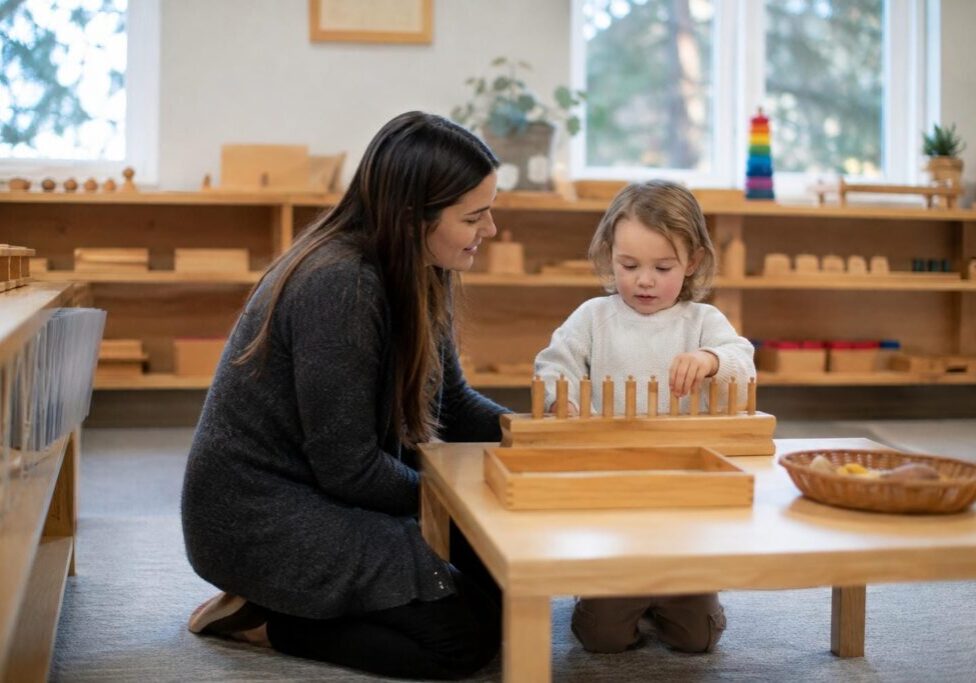
The best age to start Montessori is 3, at the beginning of a three-year cycle. That is the short answer, and the more useful version of it is a rule rather than a birthday: start at the start of a cycle, and finish the cycle you start. The strongest window runs from roughly age 3 to age 6, which is why a Pre JK to SK private school builds its early years around that exact span rather than around single school years.
Here is the tension underneath the question. A Montessori cycle wants your child at 3. Ontario’s free kindergarten opens in September of the year your child turns 4. The two calendars sit a year apart, and that offset is the whole decision. Which side of that gap your child is standing on changes what you are choosing between, and what it costs to change your mind later.
Why There Is a Best Age to Start Montessori at All
Most preschools take whatever ages come through the door in a given year and adapt around them. Montessori does not. The age bands are the method itself rather than a scheduling convenience, which is why when you start is a real question here in a way it is not somewhere else.
The First Six Years Are Treated as One Long Phase
Montessori divides childhood into four long stretches rather than school years: birth to 6, 6 to 12, 12 to 18, and 18 to 24. Each carries its own three-year curricula, built around what children in that phase are actually like rather than around a grade level. Montessori called the mind of a child under 6 an absorbent mind, meaning a child that age takes in the language, order and habits around them without being taught them directly.
For a parent choosing a room, that has a practical edge: what you are buying at this age is less a syllabus than an environment, because the environment is what the child takes in.
What Children Between Three and Six Are Primed to Pick Up
Children in this band are especially receptive to a particular set of things: order, language, refinement of movement, refinement of the senses, concentration and repetition, grace and courtesy, and independence. Those receptivities run through the first six years rather than switching on and off at set birthdays.
Language is the piece parents notice first, and a child of 3 or 4 takes on a second language by living in it, which is what makes these years the natural place for French immersion. The rest of that list matters just as much: a child who spends these years in a room built around order and independence reaches Grade 1 with work habits, not only with letters and numbers.
Montessori Designed the Method for This Age Range
Maria Montessori wrote the method for a specific age and said so. She set it out as “the educational method for children of from three to six years,” and she described the child from three to seven as being in “a formative period of life.”
So 3 is not a number a school picked to fill a room. It is the age the method was written for and shaped around. When a school says its Casa cycle opens at 3, it is following the original design rather than setting an admissions preference, which is worth knowing when you weigh a start date.
The Three Year Cycle and Why Finishing It Matters
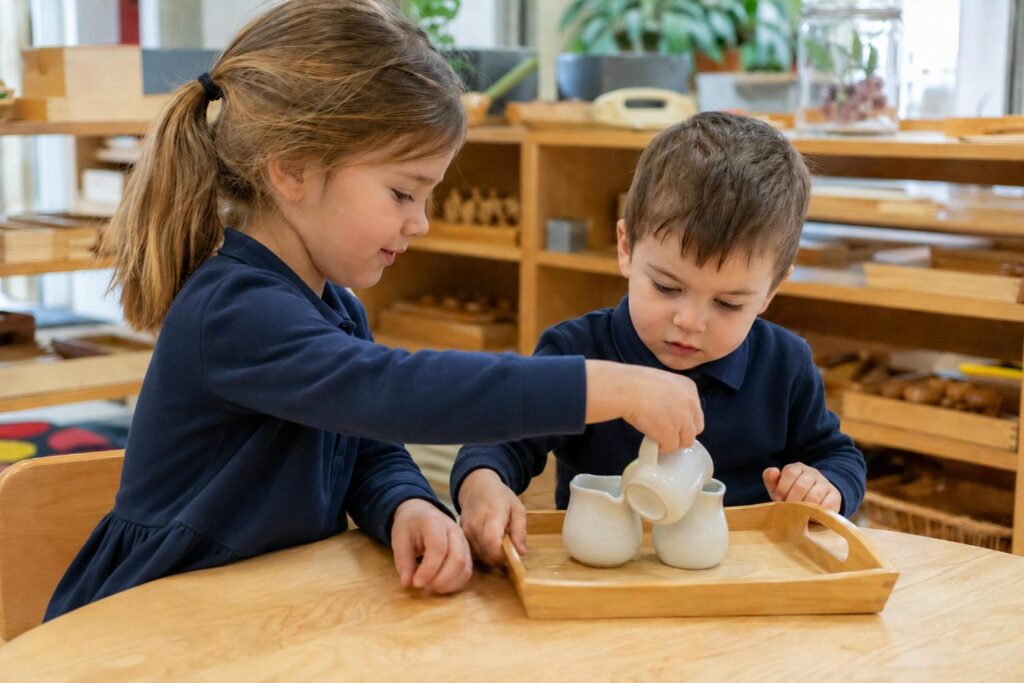
The most useful thing to understand before you pick a start date is that a Montessori classroom is a three-year run rather than three separate years stacked together. Joining it and leaving it are structural decisions that change what your child gets, not only when.
Why the Room Only Works as a Three-Year Group
A Casa classroom holds children whose ages span three years, with the same guide across all three. Younger children learn by watching older ones do work they are not ready for yet, older children consolidate what they know by showing it to someone younger, and the whole thing runs in uninterrupted work blocks of two hours or more.
That is what makes entering partway through a structural event rather than a preference. A child who arrives in year two is joining a progression already under way, in a room engineered around the fact that it is under way.
The Third Year Is the Culmination, Not a Bonus Year
The Early Childhood program runs from about 2½ to 6, and the third year, the one that lines up with kindergarten, is the culmination of it. The American Montessori Society puts it plainly: in that third year, children get their turn and take pride in being the oldest.
That year is where the first two get spent. The child who has been absorbing for two years now leads, demonstrates and consolidates, and the work they show a younger child is work they finally own. It is the payoff the structure is built for.
Which leads to the consequence worth saying out loud. A family that leaves before the third year pays for two years of a three-year cycle and misses the year the whole structure is built toward.
What the Research Says About Staying the Course
The research points the same way. A 2025 study of about 1,900 adults across Canada and the United States found the strongest results for people who attended Montessori through the preschool years, roughly ages 3 to 6. It also found that three preschool years were associated with higher reported wellbeing in adulthood than two, and that leaving at the end of a three-year cycle rather than partway through was associated with a better result again.
Earlier work in the same line found that the more years a person attended, the stronger the pattern, and that at least two years was where it started to show. Read all of it as a link rather than proof that Montessori caused it, because families who choose Montessori differ from families who do not in ways that are hard to separate out.
The Ontario Calendar This Decision Really Runs On
All of that would be simple if you were choosing in a vacuum. You are not. There is a free, competent, two-year option sitting on the table next to the tuition figure, and it runs on a different schedule than the cycle does.
What Ontario Offers and When
Kindergarten in Ontario is a free two-year program for 4- and 5-year-olds. Your child can start junior kindergarten in September of the year they turn 4, which means the calendar year of the birthday is what counts, not whether the birthday has already happened by the first day of school. A child born at the end of that calendar year is eligible the same September as a child born at the start of it.
Be fair to what is on offer. Ontario kindergarten is play-based, and classes with more than 16 students are staffed by a teacher together with an early childhood educator. That is a real program with people in it who know young children.
Why the Two Calendars Are a Year Apart
Put the two schedules side by side. The Montessori cycle opens at 3 and runs three years, so a child who starts on time is 3, 4 and 5 in the same room with the same guide. Ontario’s free option opens in September of the year the child turns 4, runs two years as JK and SK, and hands the child to Grade 1.
So a family that waits for the free year is not starting Montessori late. They are arriving roughly a year into a three-year run. If they then leave for Grade 1 on the public schedule, they have paid for two years of a three-year cycle and left before the year it was all building toward. The money went in. The third year did not come out.
That offset sits underneath the larger question of how York Region families weigh private against public, and a tuition figure alone will never show it to you.
When School Actually Becomes Mandatory in Ontario
School is compulsory in Ontario from age 6. Everything before that, junior and senior kindergarten included, is a choice your family makes rather than a requirement you are already late for.
That reframes the question. You are not asking whether you are behind. You are asking what you are buying with that year and what the alternative is worth. Nothing before age 6 is a requirement you can miss, so the timing here is genuinely yours to decide.
Entry Points by Age: What Each One Buys You
Entry age is the one variable in this decision you actually control. The rows where a child enters at the start of a cycle and stays all three years are the rows where the money and the method line up.
| Age at entry | Where the child lands in the Montessori cycle | What Ontario offers that year | What to weigh |
| Under 3 | Toddler room, a shorter cycle before Casa | Nothing publicly funded at school | Whether the family needs care or wants the start of the method; ask the school what it can take |
| 3 | Start of the three-year Casa cycle, the clean entry point | Nothing publicly funded yet | Full tuition for a year the public system does not cover, in exchange for the complete cycle |
| 4 (JK year) | One year into a cycle already running | Free junior kindergarten begins | The free option starts here; entering Montessori now means two of three years unless the family plans past SK |
| 5 (SK year) | The third and culminating year, entered from outside | Free senior kindergarten | The child joins for the year the cycle builds toward, without the two years underneath it; a real option, but ask how the room absorbs a newcomer |
| 6 and up | A new plane and a new cycle in elementary | School is compulsory from 6 | A fresh cycle start rather than a late arrival, on a different footing than a child who grew up in it |
The pattern across those rows has little to do with the birthday. What a start date costs is decided by whether the cycle gets finished, so the exit year deserves as much thought as the entry year, and often more.
Starting at Five, Six, or Later

Plenty of families reach this question holding a 5-year-old, or a 7-year-old already two years into a public classroom. A start at that age is a different proposition than a start at 3, and the specifics are what tell you whether it is worth doing.
What Changes at Six
A child of 6 or 7 is not a delayed 3-year-old. They have moved into a different phase. Where the younger child absorbs, this child reasons, and wants to know why a thing is the way it is before accepting that it is. Fairness becomes a preoccupation, and so does social order and where they fit into a world that has suddenly got much bigger than the family.
Montessori built a whole cycle for that phase, and that changes the arithmetic of a later start. A child arriving at 6 is not turning up late to the Casa cycle. They are turning up on time for the next one.
Where the Measured Advantage Is Biggest
A 2023 review that pooled studies from eight countries found positive results on both academic and non-academic outcomes, larger in Montessori preschool and elementary classrooms than in middle schools and high schools.
That comparison is narrower than it looks. It measured where children were at the time, meaning the level of school they were sitting in, and not when they first started. A teenager measured in a Montessori high school may well have been there since age 3.
So the strongest evidence sits where the method concentrates its structure, in the early and elementary years. A later start is a question we answer from the classroom rather than from that review.
Starting later is not a missed chance. The measured advantages are largest in the preschool and elementary years and smaller for older students, so a child who joins at 6 or 7 is arriving at a point where the method still has plenty to offer, just on a different footing than a child who grew up in it.
What a Later Start Actually Asks of a Child
The real question at 6 or 7 is not developmental. It is social and practical. Your child may be joining a room where the others share three years of routine, a shared vocabulary for the work, and independence habits they built together.
What helps is specific. Pairing the newcomer with one child rather than the whole group. Teaching the room’s routines directly instead of letting them be absorbed. And time measured in weeks rather than days.
The older starter brings things a 3-year-old does not. They read, they hold a longer conversation, they can be given the reason for a rule and accept it, and they can ask for what they need. A Montessori elementary program is built for exactly those capacities, which is why the work is often the easy part and the social rhythm takes longer.
Three Things That Shape the Answer Alongside Age
Age is the variable parents fixate on, and it is not the only one that moves the outcome. Three others do, and two of them sit inside your family’s control. Getting these right can matter more than landing the perfect birthday.
How Closely the School Runs the Method
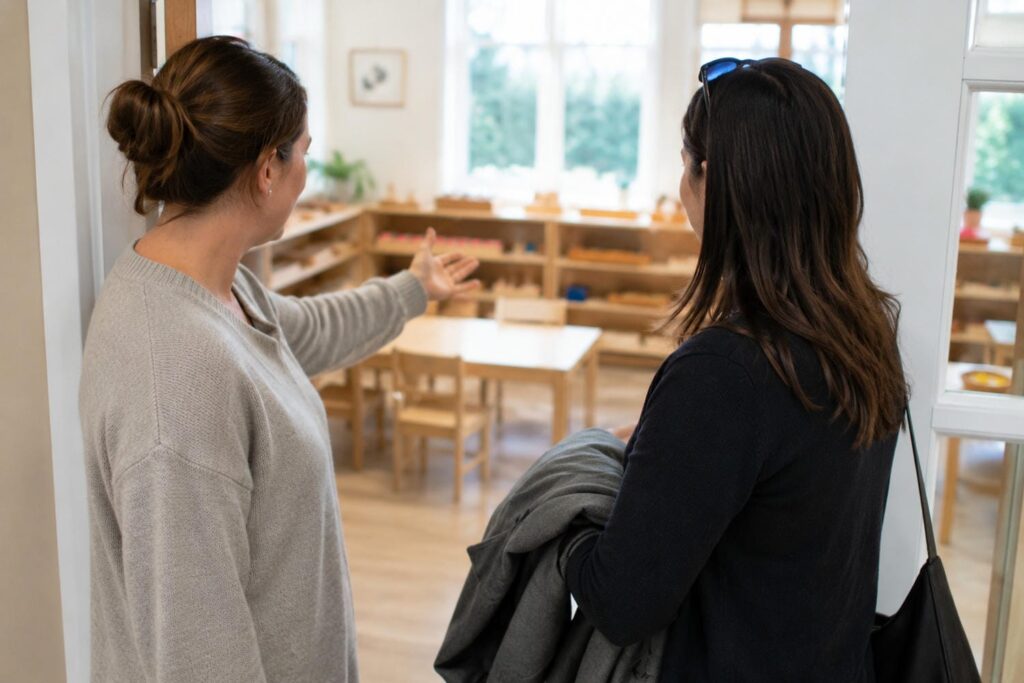
How closely a school follows the method varies, and it makes a difference to what a child gets. That is a question to ask on a tour rather than something to assume from the name on the sign.
Ask three things directly. Does the classroom actually span three years, or has it been split into single-year groups that happen to use Montessori materials? How long is the uninterrupted work period, and what is allowed to interrupt it? And what happens in the third year, since that is where a program either delivers the culmination or quietly turns into a conventional kindergarten.
Whether the Schedule Supports the Work
The uninterrupted work period of two hours or more is the engine of the Montessori day, and that one fact prices partial weeks higher than they look. A child in the room five days a week settles into a work cycle, picking up on Wednesday what they set down on Tuesday. A child in the room two days a week restarts more often than they continue.
That does not write off a family who needs a different arrangement. A part-time start is legitimate and it beats a year outside the room altogether. It is worth knowing what the schedule buys, so you choose it deliberately rather than discover it halfway through the year.
What Your Family’s Alternative Is That Year
The comparison is never Montessori versus nothing. It is Montessori versus what that particular year would otherwise be: at home, in a daycare, in free JK, or at another school. Answer that honestly and the cost question gets easier, because you are pricing a difference rather than a total.
Then weigh which mistakes are expensive to reverse. Starting a cycle and leaving it partway is the expensive one: the tuition is spent and the culminating year is the part you did not collect. Starting a year late and committing to finish is the cheap one, because your child still gets a complete run at the part that carries the most weight.
And if this is a year you are not enrolling anywhere, EarlyON Child and Family Centres run free programs across Ontario for families with children from birth to 6.
Finding the Right Starting Point for Your Child
The best age in the abstract is 3. The best age for your child depends on where the classroom groups sit in a given year, which makes it a conversation rather than a chart.
La Maison Montessori House is a French immersion, Montessori-inspired school in York Region, and our programs run from Pre JK through Grade 8, so a family can complete more than one cycle without moving a child somewhere new. Our Casa program is where the early years cycle runs, in a learning environment built around individualized attention to what each child is ready for next. The age a group can take depends on the group and the year, so the fastest way to a straight answer about your child is to ask us. You can book a time to talk with us and we will tell you where the cycle sits now, what a start this year would look like, and what waiting would look like instead.
Frequently Asked Questions
Three, at the start of a three-year cycle. The strongest window runs from roughly 3 to 6, and the rule that matters more than the birthday is to finish the cycle you start. A child who begins at 3 and stays through the kindergarten year gets the complete run the method was designed around.
Two sits below the Pre JK to SK cycle, which is built around the years from about 3 to 6. Montessori as a method does define a toddler level underneath that cycle, and the American Montessori Society puts that level at roughly 15 months to 3 years. Whether an under-3 program suits your family comes down to whether you want care or the start of the method. For what a particular group can take in a particular year, ask the school.
No. School is compulsory in Ontario from age 6, and junior and senior kindergarten are both optional. That is why starting a Montessori cycle at 3 is not starting school early. It is a decision about which room your child spends those optional years in.
No, and it helps to be clear about what 5 is: the third and culminating year of a cycle, entered from outside it. Your child joins for the year the structure builds toward without the two years underneath it, which is a real option and a different one. Ask the school how it absorbs a newcomer into that year, and how the routines get taught rather than assumed.
Yes, and it is better understood as a cycle start than a late arrival. Elementary is its own three-year structure, built for a phase where children reason, argue, and want the reason behind a rule before they accept it. A child entering at 6 begins that cycle at the beginning, alongside everyone else who is starting it.
At least one complete cycle. Two years is where measured benefits start to show, three years is associated with better results than two, and leaving at the end of a cycle beats leaving partway through. If you can only commit to part of it, plan the exit at a cycle boundary rather than at a convenient point in the middle.
It is a legitimate choice and plenty of families make it work. Just know what it does to the calendar: your child arrives about a year into a three-year cycle. So the part to plan carefully is not where they enter but where they exit, because entering at 4 and leaving for Grade 1 collects two years of a three-year structure and skips the culminating one.
Usually a year ahead of the start you want, because applications for a September start generally open the year before. In practice, the year you are deciding for is the one after the year you are standing in. Worth checking on the public side too: not every school board starts its year in September and some begin in August, so look up your own board’s dates before you assume the two calendars line up. Knowing when applications open for fall entry keeps this from becoming a scramble.