Ontario Inspected Private School Status in York Region, Explained
Category: Insights

An Ontario inspected private school is one the Ministry of Education inspects so that it may grant course credits toward the Ontario Secondary School Diploma. That makes inspection a credit-integrity status rather than a quality rating, and the difference matters more than almost any other fact in this area. It is also why no private elementary school in Ontario is inspected, including every Montessori elementary school, and why that says nothing at all about the school. If you are comparing every private school in York Region and trying to read what the province’s label on each one actually means, the labels are doing less work than they appear to. By the end of this you will be able to look at any school’s provincial status, in Newmarket, Aurora, Richmond Hill or Markham, and know exactly what it does and does not tell you.
What Ontario Inspected Private School Status in York Region Covers, and What It Leaves Out
The status is real, and it is narrow. Parents tend to read “inspected” as a general seal on a school: the building, the teachers, the classroom, the care. The actual scope is much tighter than that, and knowing where its edges sit is what lets you weigh it correctly against everything else on your shortlist.
The Status Exists to Protect Diploma Credits
The Ministry of Education inspects all private high schools that are seeking, or already approved, to grant course credits toward the Ontario Secondary School Diploma. It does not inspect private elementary schools, and it does not inspect private high schools that do not offer credit courses. The program’s boundary follows the credit, not the school. What the province stands behind when it inspects is the transcript: the assurance that a credit stamped OSSD was earned under a reviewed standard of instruction. Inspection is a promise about a document, and a good one. It was never designed to answer whether a school is right for your child.
What an Inspector Actually Reviews
An inspection is a document and classroom review aimed squarely at instruction. Inspectors look at the school calendar, course outlines and lesson plans. They visit classrooms, review student work, and examine the school’s policies, procedures and records. The organizing question is whether the standard of instruction supports the credits the school issues. That is a substantive review, and schools that hold it have earned something real. It is worth knowing what it measures so you can tell what remains yours to check.
What an Inspection Does Not Look At
Ministry inspectors do not inspect the condition of the premises, health and safety practices, or staffing. This is the most useful correction most parents can make to their mental model, because those three things sit near the top of what any parent worries about, and none of them is what inspection covers. Frequency follows the same logic: how often a school is inspected depends on its prior reports, with inspectors able to recommend a return in two years, the next school year, or within the same school year, while new schools are inspected as early as possible in year one and an unannounced inspection is possible where there are concerns about instruction or credit integrity. Every one of those triggers is about instruction and credits.
Why No Private Elementary School in Ontario Is Inspected
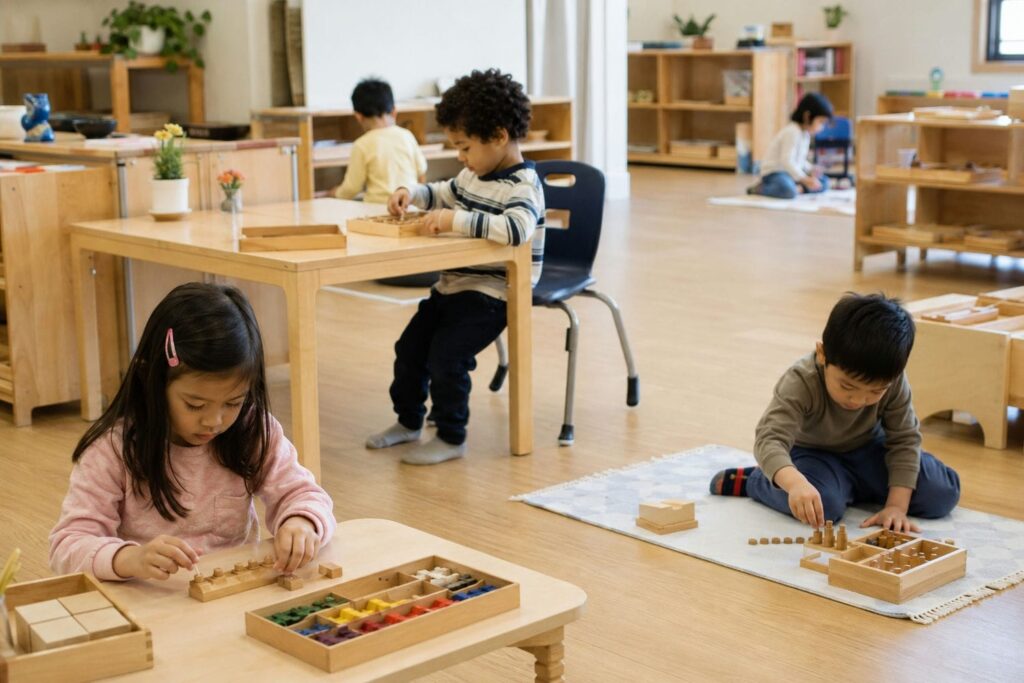
This is the most misread fact in the whole area, and it is worth stating calmly as a mechanism rather than as a defence. Nothing here is about a school’s ambition, its quality, or its willingness to be looked at. It is about what the inspection program was built to protect, and where that protection has anything to attach to.
There Are No Diploma Credits to Inspect Before High School
Diploma credits belong to high school. The Ontario Secondary School Diploma is counted from the year a student enters Grade 9, which is why the province’s inspection program is aimed at high schools that grant those credits. An elementary classroom issues none, so an inspection there would have nothing to inspect: no course outlines tied to credits, no transcript entries to verify, no credit integrity at stake. So the absence of inspection at the elementary level is a boundary in how the program is designed. It is not a school choosing not to apply, and it is not a school failing to qualify. Every elementary school in Ontario sits outside it.
Why There Are No Credits to Transfer Before High School
Parents usually reach the next question quickly: if the elementary years carry no credits, what happens if we move? Because the elementary years issue no diploma credits anywhere in Ontario, publicly funded or private, there is nothing to lose in a move and nothing to transfer. A move into a publicly funded school is a placement decision, not a credit transfer. According to the Ministry of Education, the principal of the receiving school places the child in an age-appropriate grade, working from documentation such as attendance records, report cards and other assessment materials, and from conversations with you, your child and school staff. Another private school sets its own placement practice, so ask how it does it. That documentation list is the practical takeaway: attendance records, report cards and assessment materials are what a receiving principal actually works from, which is why they are worth having in hand. If a move happens later at the high school level, there is a named provincial process for recognizing prior learning.
How to Read a School’s Status Without Misreading It
Three phrases turn up constantly on school websites, and they describe three unrelated facts. “Registered with the Ministry” means the school filed its annual notice that it intends to operate. “Inspected” means it grants OSSD credits under provincial review. “Accredited” means a private association reviewed it against that association’s standards. None of the three is a version of the other two. Worth knowing as well: “non-inspected private school” is the province’s own term, used verbatim as a heading in provincial policy, so it names a recognized category rather than a school that missed a bar. And if a York Region elementary school tells you it is Ministry-inspected, it is describing something that does not exist at that level, so it is fair to ask what they mean.
What Changes When a School Is Inspected, and What Does Not
The two columns differ in fewer places than most parents expect. Inspection changes one thing: whether the school can put credits on a transcript. The rows that stay identical are the ones that actually govern a young child’s day.
| What the status covers | Inspected private school (high school, OSSD credits) | Non-inspected private school (including all elementary) |
| Authority to grant OSSD credits | Yes, this is the reason for inspection | No, and none are issued at the elementary level |
| Ministry review of instruction | Reviewed against the standard of instruction | Not reviewed by the Ministry |
| Ontario curriculum required | Followed for credit courses | Not required, though general subjects such as mathematics, science, language and social studies should be offered |
| Annual notice of intention to the province | Required | Required |
| Public health, fire, building and municipal law | Applies | Applies |
| Voluntary association accreditation | Possible, separate from inspection | Possible, separate from inspection |
What Every Ontario Private School Must Do, Inspected or Not
It is easy to hear “not inspected” and conclude that a school sits outside any system at all. That is not the picture. Obligations exist at every private school in the province, and more of them touch a young child’s daily experience than inspection ever would. They are simply not the obligations parents assume.
The Annual Notice of Intention, Due September 1
Every private school operator in Ontario must notify the Ministry annually of its intention to operate, and the submission is due by September 1 each year. That applies to newly established and continuing schools alike, and the electronic notice becomes available to existing operators in June. This is the transaction that puts a school on the province’s list, and it is a filing rather than an approval. It is also worth separating cleanly from anything you have to do: the deadline is a school’s obligation to the province and has no bearing on the family application timeline, which runs on its own schedule.
What Counts as a Private School in Ontario
The definition is more mechanical than most people expect. Ministry guidance sets out three conditions: instruction is provided at any time between 9 a.m. and 4 p.m. on a school day, five or more students at or over school age attend, and elementary or secondary subjects are offered. Meet all three and you are a private school in the eyes of the province, with the filing duties that follow. Ontario’s private schools operate under the Education Act, which sets out who must attend school and what a private school is required to do, and these requirements sit inside that framework.
Curriculum Freedom and What It Means for a Program
Schools the Ministry does not inspect do not need to follow the Ontario curriculum, though they should offer general elementary or secondary subjects such as mathematics, science, language and social studies. This is the legal ground a Montessori-inspired or French immersion program stands on. It is what allows a classroom to sequence mathematics by material and readiness rather than by a provincial grade schedule, or to run a full day in French. It also reframes your shortlist question, because “what do you teach, and why did you choose it” tells you far more than “are you inspected” ever will, and if you want the fuller picture of how private and public schools differ, that comparison deserves its own look.
Who Oversees a York Region Private School Beyond the Ministry
The Ministry runs a real evaluative program, and it runs it where credits are at stake. Beyond that program, a private school answers to a set of bodies most parents never think to ask about, and for a four-year-old or a nine-year-old those bodies matter more day to day. Most of them are local.
Immunization Requirements Apply at Private Schools Too
Children attending a private school are required to have proof of immunization exactly as children attending a publicly funded school are. In York Region that means the standard childhood series, plus varicella for younger students born after 2010. Two details surprise nearly every parent we speak with. First, you report your child’s immunizations to York Region Public Health yourself, because neither the school nor your health care provider passes that information along. Second, a student can be suspended for up to 20 school days if their record is not up to date and no valid exemption is on file. That is enforcement with real teeth, and it comes from public health rather than from education.
Buildings, Fire Safety and Municipal Rules
Since ministry inspectors do not look at premises, the bodies that do are the ones covering any place where children gather. Municipal building and zoning staff decide whether a property may operate as a school at all, and whether its occupancy, exits and washrooms suit that use. The local fire service inspects alarms, extinguishers, exits and evacuation planning. Public health covers food handling, sanitation and outbreak response. So a parent standing in a hallway wondering about the stairwell has a real avenue, and it runs through the municipality and the regional health unit. Asking when the last fire inspection was, and who holds the school’s occupancy approval, gets a straight answer from any well-run school.
How to Look Up a York Region Private School Yourself

You probably came here to check something specific about a specific school. The province publishes enough for you to do that in a few minutes, provided you know what the tool is and what it will not do.
Where the Province’s List Lives and What Is in It
The Ministry publishes a private school contact information dataset through the Ontario Data Catalogue, drawn from what schools themselves report and refreshed monthly. The fields include school name, school number, credits offered, principal, address, city, region, school level, program type and association membership. Set your expectations before you click: this is a spreadsheet you download, not a search box you type a name into. Open it, filter the region column to York Region, and you have every private school the province has on record locally, sitting in one view.
Reading the Fields That Actually Answer Your Question
Three columns do nearly all the work. School level tells you whether the school is even within the inspection program’s range, which settles most confusion before you read anything else. Credits offered is the honest test of any OSSD claim, because a school that grants none will show none. Association membership shows which voluntary body, if any, the school reports working with, and that is the fact behind a website’s “accredited” line. Put a school’s marketing copy beside those three fields and you will know in about two minutes whether the two agree. Where they disagree, that is a fair question to put to the school directly.
Accreditation Is a Different Instrument Than Inspection

When a parent asks whether a school is “approved”, accreditation is usually what they are reaching for without having a name for it. It is a genuine form of review, it is the one most elementary private schools actually undergo, and it comes from an entirely different place than the province.
How Voluntary Accreditation Works
Accreditation is voluntary and runs through independent associations rather than through government. An association publishes standards, sends trained peer reviewers to visit the school, and re-reviews on a set cycle so a passing review does not last forever. Those standards tend to cover governance, leadership, planning, safeguarding and the school’s own improvement processes, examined by people who run comparable schools. That is a different kind of assurance than a provincial review of instruction, and neither substitutes for the other. Treat accreditation as evidence that a school invited outside eyes in and was willing to be told things.
What to Verify When a School Calls Itself Montessori
Any school can describe itself as Montessori, so the things worth checking are the teacher training behind the classroom, the materials in it, and the multi-age structure. Ask which diploma the lead teachers hold and which body issued it. Walk the room and look for the full sequence of materials rather than a shelf of highlights. Ask about the age span in each class too, because how multi-age classrooms actually work is the part of the method most visible to a visitor and hardest to fake. On qualifications generally, certification by the Ontario College of Teachers is required to teach in a publicly funded school, and many private schools also require it, so ask how a school’s teachers are qualified and trained. Montessori accreditation itself is voluntary, runs through independent associations rather than the province, and is renewed on a set cycle, so ask which association a school works with and when it was last reviewed.
Three Status Questions Worth Asking Before You Enrol
Once you know that provincial status was never going to grade a school for you, the useful questions get sharper. These three are document and status checks, and each has a clear answer a school either has or does not.
- Which association, if any, has reviewed the school, and when was that review last done? A confident school names the body and the year without hesitating.
- How does the school keep attendance and student records, and what would go with your child if you moved schools? You are asking what lands in a receiving principal’s hands.
- If the school mentions credits or diplomas anywhere in its materials, what exactly is it authorized to grant? At the elementary level the honest answer is nothing, and that is the answer you want.
Those three cover status. The broader visit deserves its own preparation, and what to ask on a school tour covers the classroom, the teachers and the day itself.
Deciding With the Right Information, Not the Right Label
Once you understand that a provincial label was never going to answer whether a school suits your child, the real evaluation opens up: the program, the classroom, the teachers, and how your particular child would spend a Tuesday morning. That is what a visit is for. La Maison Montessori House is a French immersion private school serving York Region families, with programs from Pre JK to SK through Elementary and a Montessori-inspired approach built around individualized attention, and we are glad to walk you through exactly what we hold and what we do not, and why. If you are still mapping out private education in York Region, that context is a useful place to start. When you are ready to see a classroom during a working morning, get in touch with our admissions team and we will find a time that fits your family.
Frequently Asked Questions
It means the school grants credits toward the Ontario Secondary School Diploma and the Ministry reviews its standard of instruction so those credits can be trusted. Inspectors look at course outlines, lesson plans, student work and school records, and they visit classrooms. It is not a quality rating and it is not a licence to operate. The status answers one question well: whether a credit on a transcript from that school means what it says.
Because the inspection program exists to protect diploma credits, and elementary schools issue none. With no credits to verify, there is nothing for the program to reach, so every private elementary school in Ontario sits outside it by design. This is a category boundary rather than a shortfall, and it applies equally to the newest school in the province and the most established one. It carries no information about a school’s quality.
Yes. Every private school in Ontario files an annual notice of intention to operate with the Ministry, and that filing is what the province requires. Beyond it, the school is subject to the same public health, fire, building and municipal law as any other place where children gather, enforced by the local health unit, the fire service and the municipality. Not being inspected is a normal status, not an irregular one.
They are three unrelated facts. Registered means the school filed its annual notice with the province. Inspected means the province reviews its instruction because it grants OSSD credits. Accredited means an independent association reviewed the school against that association’s own standards, voluntarily and separately from government. A school can be any combination of the three, and none of them implies either of the others.
No. Schools the Ministry does not inspect are not required to follow the Ontario curriculum, though they should offer general elementary or secondary subjects such as mathematics, science, language and social studies. This is what makes a Montessori-inspired sequence or a French immersion day possible. The better question for your shortlist is what a school teaches and why it chose that approach, since that is where the real differences between programs live.
Download the province’s private school contact information dataset and filter its region column to York Region. The file is a spreadsheet rather than a search page, it is refreshed regularly, and it draws on what schools themselves report. Alongside a school’s name and address you will see its school level, credits offered and association membership, which together let you check a school’s own description against what it reported to the province.
No. Ministry inspectors do not review the condition of premises, health and safety practices, or staffing. Those areas belong to other bodies: municipal building and zoning for the property, the local fire service for alarms and exits, and public health for immunization, sanitation and food handling. If you have a question about a building or about how staff are qualified, the answer comes from the municipality, the health unit, or the school itself.