
Montessori And French Immersion: Why The Combination Works So Well
Category: Insights
A Montessori French immersion program works well because children learn language best when it is active, meaningful, and connected to real experience. Montessori gives French a practical classroom context through movement, materials, routines, songs, stories, conversation, and independent work, while French immersion gives Montessori learning a richer bilingual environment. For York Region families, the strength is not Montessori plus French as two separate features. It is how the two approaches support each other throughout the school day.
This combination matters because children do not build language confidence through memorization alone. They need repeated exposure, useful vocabulary, adult guidance, and enough comfort to try. Montessori gives students something real to do with language, while French immersion helps that language become part of thinking, learning, and daily participation.
For families comparing schools, the key question is simple: does the classroom make French feel useful, natural, and connected to the child’s work? When Montessori and French immersion are integrated well, children are not only learning French. They are using French as part of a full school experience.
Montessori And French Immersion At A Glance
Montessori and French immersion work together because both rely on meaning, repetition, and active participation. A strong bilingual Montessori environment does not treat French as a stand-alone lesson that sits apart from the rest of the day. It gives children many chances to hear, understand, and use French through real routines, concrete materials, songs, stories, social interactions, and guided classroom work.
| Montessori Element | How It Supports French Immersion | Why It Matters |
| Hands-On Materials | Gives words a concrete meaning | French connects to real objects, actions, and ideas |
| Repetition | Builds comfort through repeated exposure | Children hear and use language often |
| Practical Life | Connects French to daily routines | Vocabulary becomes useful and natural |
| Independence | Encourages participation and confidence | Children practise without waiting for perfect fluency |
| Multi-Age Community | Creates peer modelling | Younger students hear older students use language |
| Integrated Curriculum | Makes French part of learning | Language supports thinking across subjects |
The core takeaway is that Montessori gives children something real to do with language. French immersion gives that work a bilingual environment. Together, they can help children build comfort, vocabulary, independence, and confidence through experience rather than pressure.
Why These Two Models Fit Together
Montessori is not just a classroom style, and French immersion is not just vocabulary instruction. The combination works because both approaches are strongest when learning is purposeful, repeated, and connected to the child’s real world. Children need to touch, move, ask, listen, sort, observe, repeat, and try again.
In a Montessori French immersion setting, language becomes part of the work. A child may hear French during a greeting, a practical life activity, a math lesson, a song, a story, a peer exchange, or a teacher’s quiet guidance. That creates more natural contact with language than a model where French appears only in isolated blocks.
Language Is Learned Through Use, Not Memorization Alone
Children need to hear and use language in meaningful situations. In a Montessori French immersion classroom, French can appear during greetings, classroom routines, teacher guidance, circle time, work periods, songs, stories, social exchanges, and subject-based learning. The child does not only hear a word. They hear it attached to an action, object, question, or routine.
This matters because early second-language learning often begins with understanding before confident speech. A child may recognize instructions, follow classroom cues, or respond through action before speaking with ease. That is not failure. It is part of how language grows.
The goal is not to make every child speak perfect French right away. The goal is to make French familiar, useful, and connected to the child’s daily world. That is where Montessori gives immersion a strong foundation.
Montessori Gives Children Context For French
French becomes easier to understand when children can see, touch, move, sort, count, pour, match, trace, and describe. Montessori materials give children visual and sensory context, which can make new vocabulary less abstract. A word becomes easier to remember when it is tied to a colour tablet, a number rod, a pouring exercise, a map, a story, or a real classroom task.
This is especially helpful for children who are still building confidence in a second language. They can participate through movement and work before they can express everything verbally. The material helps carry meaning while the language catches up.
Families weighing classroom philosophies often want a clear sense of how Montessori differs from more traditional classroom models, from the role of the teacher to how children move through their day.
Independence Helps Students Take Risks With Language
Children often need confidence before they speak freely in a second language. Montessori supports that confidence by giving children freedom within a prepared environment, with purposeful choices, clear expectations, self-correction, and teacher guidance. The child can practise, repeat, and try again without feeling that every moment is a public test.
This matters for French immersion because language risk-taking is part of learning. Children need room to try a phrase, make a small error, listen again, and return to the work. When the classroom supports independence, a child can build confidence through action as well as speech.
Montessori independence helps children build self-confidence, self-reliance, and pride when they accomplish goals. That confidence is directly relevant to language learning because children are more likely to use French when they feel safe enough to try.
How Montessori Materials Support Bilingual Learning
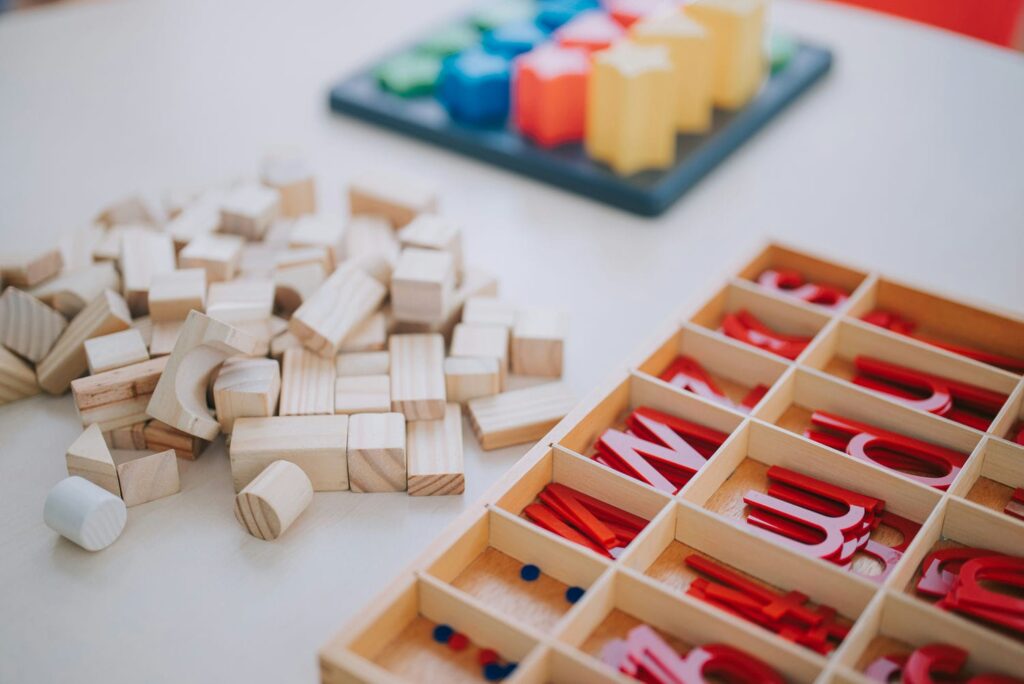
Montessori materials are not decorative extras. They help children connect language to experience. In a French immersion setting, that connection can make new vocabulary more concrete, more repeated, and easier to use.
For parents, this is one of the most important parts of the model to understand. A child learning French needs more than word lists. They need a prepared environment where words are connected to objects, movements, choices, relationships, and results.
Concrete Materials Make New Vocabulary Easier To Grasp
When a child is learning French, concrete materials reduce guesswork. A teacher can name colours, shapes, textures, quantities, actions, positions, and relationships while the child is working with something visible and meaningful. The child hears language while seeing what the language describes.
This makes French more natural. The child is not only memorizing a word. They are connecting the word to a movement, object, choice, correction, or outcome. That concrete link can make language feel less abstract and more useful.
For example, a child may learn language through sorting, matching, counting, tracing, building, washing, folding, or presenting. Each task gives the child a reason to listen and a reason to understand.
Repetition Builds Confidence Without Turning Learning Into Drills
Montessori repetition is purposeful. Children often return to materials because they are still mastering a skill, refining movement, deepening understanding, or enjoying the work. That repeated contact supports French immersion because children hear and use related vocabulary many times.
Repetition also reduces pressure. Instead of expecting instant fluency, the environment gives children many chances to hear the same classroom phrases, instructions, and ideas in familiar contexts. Over time, language starts to feel predictable.
For French immersion, that matters. Confidence usually grows after children understand patterns. The repetition feels like part of classroom life, not a disconnected worksheet loop.
Self-Correction Keeps Children Engaged
One strength of Montessori materials is that they often help children notice and correct errors. This matters in French immersion because children can build confidence through discovery instead of constant adult correction. They learn that mistakes are part of work, not a reason to stop trying.
Self-correction also supports independence. A child can test an idea, see whether it works, adjust, and continue. In a language-rich classroom, that same habit helps children approach French with more resilience.
Dr. Montessori built self-testing into the materials, and our teachers continuously observe, assess, and guide student progress. That gives parents a clear way to understand how structure and independence work together inside a Montessori French immersion environment.
Why Early French Immersion Feels Natural In A Montessori Setting
Early French immersion can feel natural in a Montessori setting because young children often learn language through rhythm, routine, movement, songs, stories, and social cues. They do not need every word explained in an adult way before they begin to participate. They often understand through context first.
This is where Montessori can support young language learners well. The classroom already depends on routine, practical activity, hands-on materials, movement, and respectful social habits. Those elements give French many useful entry points throughout the day.
Children Absorb Language Through Routine And Movement
Young children often understand language through repeated routines before they can explain the language back. A child may learn classroom French through greeting, choosing work, washing hands, cleaning up, eating lunch, going outside, joining circle time, or following a teacher’s gentle direction.
Movement helps because the child is not sitting still trying to decode language in isolation. They are doing something. The action gives context, and the repeated routine makes the language more familiar.
This is why Montessori and early French immersion can fit so naturally. The child hears French during real tasks that already matter to the school day.
Songs, Stories, Practical Life, And Grace And Courtesy Support Real Language
French should not feel like a separate performance for young children. It can be built through songs, stories, courtesy phrases, practical life activities, classroom responsibilities, and social routines. These moments help children attach language to warmth, rhythm, care, and belonging.
Practical life activities are especially useful because they give children repeated words and actions. Pouring, folding, carrying, cleaning, greeting, waiting, sharing, and asking for help all create natural reasons to listen and respond.
Sensory learning, practical life, grace and courtesy, social development, and early French through songs, stories, and interactive activities all shape our Pre JK to SK program.
Early Exposure Builds Comfort Before French Feels Academic
A major benefit of early exposure is comfort. Children can begin to associate French with school life, relationships, routines, and discovery before language becomes something they study more formally. That comfort can make participation feel less intimidating later.
This does not mean every child follows the same timeline. Some children speak quickly, while others listen and absorb before using more language aloud. The important question is whether the environment supports steady confidence.
For families, this makes early Montessori French immersion less about rushing fluency and more about building familiarity. French becomes part of the child’s school world before it becomes a subject to perform.
Why The Combination Still Matters In Elementary
Montessori French immersion is not only an early-years idea. In elementary, the combination can support deeper thinking, project work, independence, research, presentations, and more meaningful use of French across subjects. Older students need language for expression, analysis, organization, and discussion.
This is where the integrated nature of Montessori becomes valuable. When subjects connect, French can connect too. Language supports thinking rather than sitting apart from it.
Integrated Studies Make French More Meaningful
Montessori often connects subjects rather than treating them as isolated blocks. That matters for French immersion because language can support history, geography, science, math, culture, oral presentation, and project work. A student can use language to explore ideas, not only to repeat vocabulary.
Montessori schools teach familiar subjects such as math, science, history, geography, and language through an integrated approach. A study of Africa, for example, might connect art, history, ancient Egypt, writing, and geometry, so students become immersed in a topic rather than simply moving from one disconnected subject to another.
For French immersion, this means language can attach to bigger ideas. Students can use French as part of learning, not just as something they practise apart from learning.
Project Work, Presentations, And Research Support Active Use
In elementary, students need more than basic French vocabulary. They need to explain, question, organize ideas, present information, and communicate with growing precision. Project work, presentations, and research can help students use language actively and with purpose.
This also helps students build confidence. When children use French to share an idea, explain a process, or participate in a larger study, the language has a reason behind it. It becomes part of communication, not just recitation.
Our elementary program brings together advanced French immersion, language work, science and technology, learning skills, geography, history, and physical education in an environment that supports responsible, thoughtful, independent learners.
Time Management And Independence Carry Forward
Parents may wonder whether a Montessori French immersion environment prepares students for later academic settings. That is a fair question. The answer depends on whether independence becomes practical through planning, responsibility, assessment habits, and communication skills.
In Montessori, independence should not mean a lack of expectations. It should mean students gradually learn how to manage work, track responsibilities, plan ahead, and take ownership of learning. Those habits matter in elementary and beyond.
Our students begin using journals in Year 3, and sometimes earlier, to record daily and weekly work, plan ahead, and track remaining tasks. Elementary students also complete annual CAT testing, so they become familiar with formal testing well before high school.
What Parents Often Misunderstand About Montessori French Immersion
Parents often hear simplified opinions about both Montessori and French immersion. Some people assume Montessori is too loose. Others assume French immersion only works for children who already know French or have French-speaking parents. These assumptions can make a strong-fit option seem riskier than it really is.
The better approach is to ask how the combined model works in practice. A strong Montessori French immersion school should be able to explain structure, support, adjustment, progress, and how French is integrated into the school day.
It Is Not Less Structured
Some parents think Montessori means children do whatever they want. A better way to understand it is freedom within a prepared environment. Children have choice, but the environment is intentional, the materials are purposeful, the routines are clear, and the teacher observes and guides progress.
That structure may look different from rows, worksheets, bells, and constant whole-class instruction. However, different does not mean unstructured. In a Montessori French immersion environment, structure often appears through routines, expectations, repeated presentations, careful observation, and the child’s growing responsibility.
For language learning, this matters because children need both room to try and enough support to progress. Montessori can provide both when the environment is well prepared and the teachers are guiding carefully.
It Is Not Only For Children Who Already Speak French
Children do not need to arrive fluent, and parents do not need to speak French at home. However, families should ask what the adjustment period looks like and how the school supports children when French is new. A strong answer should be practical, not dismissive.
Many of our students do not begin with prior French, and many parents are not French-speaking either. There is a normal adjustment period where students build the vocabulary and skills needed to participate and communicate.
Some families want to dig deeper into the common French immersion myths and what is actually true about how children adjust, progress, and thrive in a bilingual setting.
It Is Not Just A Language Program With Montessori Materials
The combination is strongest when the philosophy and language environment work together. French should be part of how students move, work, ask, respond, explore, present, and build relationships. Montessori materials alone do not create the full value. French language blocks alone do not create it either.
The value is integration. The child learns in a prepared environment where French is connected to real work, and the Montessori method is strengthened by a bilingual context.
That is the difference between a school that offers two attractive features and a school that has built those features into one coherent learning experience.
What To Compare When Considering A Montessori French Immersion School
Parents do not need to become education experts before choosing a school, but they should know what to look for. The best questions focus on daily use, classroom environment, teacher guidance, and continuity from early years into elementary.
This section is not a full school-selection checklist. It is a practical way to test whether the Montessori French immersion model is truly visible in the school experience.
How Much French Is Lived Across The Day?
Parents should ask where French appears in the day: circle time, work periods, practical life, social routines, presentations, subjects, songs, stories, and teacher guidance. The stronger question is not “Do you offer French?” It is “How is French used in the normal rhythm of the day?”
Labels can sound similar while the lived experience is very different. A program may use French in short blocks, or it may make French part of classroom life across the day. That difference matters for families who want an immersive experience.
Across the province, Ontario’s French as a second language programs take several different forms, so families benefit from comparing structure and daily use rather than relying on program labels alone.
How Does The Classroom Environment Support Independence?
Parents should look for accessible materials, purposeful work, clear routines, child responsibility, and teachers who guide without overdirecting. This helps them see whether Montessori is actually lived in the classroom rather than used only as a description.
A prepared environment should help children make choices, stay focused, solve problems, and care for the classroom. In a French immersion setting, that same environment gives students more natural opportunities to hear and use language.
Our classrooms are designed to foster independence, concentration, and a joy for learning, with accessible materials that encourage exploration and problem-solving.
How Do Teachers Guide Progress?
In a Montessori French immersion setting, teacher guidance should include both language development and broader academic growth. Parents should ask how teachers observe, document, support, and communicate progress. They should also ask how the school knows when a child is ready for new lessons or additional support.
This matters because Montessori should not be passive. Teachers are not simply stepping back. They are watching closely, introducing materials, supporting language, guiding independence, and helping the child move forward.
Our educators are guides who connect students with their environment, and each member of our staff is extensively trained in the Montessori method.
What Does The Path From Pre JK To Grade 8 Look Like?
The combination becomes stronger when families can see continuity. Parents should ask how French, independence, practical life, academic foundations, project work, and leadership develop as children move from the early years into elementary.
For younger children, the focus may be routine, movement, early language, sensory learning, grace and courtesy, and comfort with French. For elementary students, the focus may expand into advanced French, integrated studies, presentations, research, technology, physical education, and time management.
Why This Matters For York Region Families
York Region parents are often comparing more than one factor at the same time. They may be weighing French immersion, Montessori, public versus private school, commute, cost, child fit, and long-term confidence. That makes the combined model especially relevant when families want both bilingual learning and a more individualized educational environment.
The goal is not to say Montessori French immersion is the right fit for every child. The goal is to help families understand what the model can offer and how to evaluate whether it fits their child.
The Combination Solves More Than One Decision At Once
For some families, Montessori French immersion answers two major questions at the same time. They want a bilingual environment, and they want a more hands-on, individualized learning model. That is different from choosing a school only because it offers French.
We are the only French Montessori school in York Region. That local distinction matters for families who are not just seeking French immersion, but French immersion in a Montessori environment.
When the two approaches are integrated, families do not have to treat language and learning philosophy as separate decisions. They can look at how both show up in one school day.
The Right Fit Depends On The Child, Not Just The Philosophy
A strong philosophy still has to fit the child. Parents should look at how the school supports confidence, attention, social development, independence, language adjustment, and family communication. The model matters, but the child’s experience matters more.
Some children need more time to warm up. Some need more challenge. Some need a calm routine, while others need movement and independence to stay engaged. The best school decision comes from matching the model to the child rather than choosing by label alone.
A Tour Should Show The Combination In Practice
A tour should make the combination visible. Parents should see French used naturally, materials supporting real learning, children working with purpose, and teachers guiding with intention. If the model is real, it should appear in the classroom, not only in the school description.
Good tour questions help families move past first impressions. Ask how French is used, how materials support learning, how independence is taught, how progress is tracked, and what the school expects from students at different ages.
A short list of private school tour questions can help families compare what they hear during a visit with what they actually see in the classroom.
See How Montessori And French Immersion Come Together In Our Classrooms
Montessori French immersion makes the most sense when families can see how the language environment and classroom model work together. We are the only French Montessori school in York Region, offering French immersion from Pre JK through Grade 8, with more than 20 years in business and over 2,000 students graduated. Our educators are extensively trained in the Montessori method, so the language environment and classroom model genuinely support each other. Families who want to see how the combination is structured can start with our French immersion program, get a fuller picture of the private school experience at La Maison Montessori House, or move directly to admission next steps.
Frequently Asked Questions
Montessori gives French a concrete, hands-on context. Children hear and use French while working with materials, following routines, singing, listening to stories, and participating in classroom life, which makes language feel useful rather than separate from the rest of learning. The combination works best when French is woven into the day rather than treated as a small add-on, since children need repeated, meaningful exposure to build confidence.
Yes, when the environment is well prepared and teachers guide progress carefully. Montessori structure shows up through routines, purposeful materials, observation, expectations, and repeated practice rather than constant whole-class instruction, and parents should ask how the school supports children who are new to French and how teachers decide when a child is ready for new work.
Not necessarily. Many children begin French immersion without any prior French, but families should still ask how the school supports beginners and what the adjustment period looks like, because the key is whether the program helps the child build vocabulary, confidence, and participation over time rather than whether they start fluent.
No. Parents can support their child with routine, encouragement, reading habits, curiosity, and clear communication with the school, and a strong program should be able to explain how non-French-speaking families can stay involved and understand their child’s progress.
No. In elementary, the combination supports integrated studies, project work, presentations, independence, time management, and more advanced French use across subjects, while the early years build comfort and routine that elementary then deepens through language, thinking, research, and communication.
The main difference is the learning environment. Montessori French immersion uses hands-on materials, self-directed work, teacher observation, routine, and integrated learning to make French part of the child’s daily experience, where a traditional program may also be strong but treats language as a more separate subject.
Look for French used naturally, children working with purpose, accessible materials, teacher guidance, clear routines, and evidence that the school can explain both language progress and broader academic development, and ask how the model changes from early years into elementary so you understand the full path rather than just the current classroom.